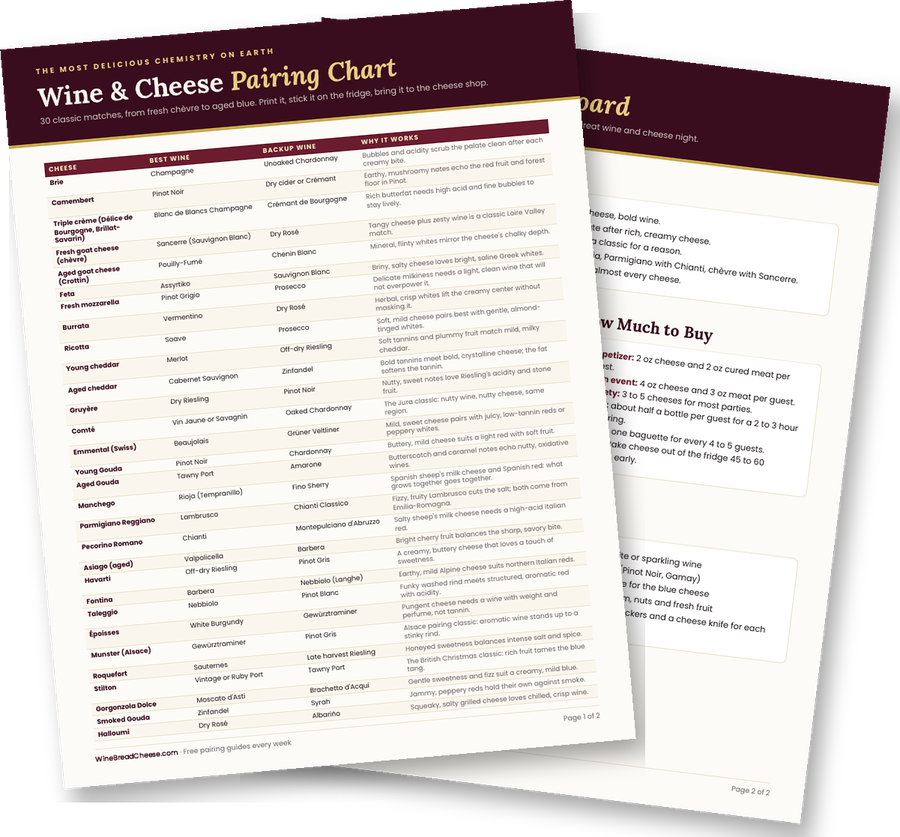
Quick answer: The most reliable wine and cheese pairings match intensity and texture: fresh, tangy cheeses like goat cheese love crisp Sauvignon Blanc, creamy bloomy rinds like Brie shine with Champagne or Chardonnay, aged hard cheeses like Parmigiano Reggiano and aged cheddar want structured reds, and salty blues are best with sweet wines like Sauternes or Port. The chart below covers 30 classic cheeses with a best wine, a backup bottle and the reason each match works.
This post contains affiliate links. We may earn a small commission at no extra cost to you.
Whether you are planning a party, building a board for two or just standing in the cheese aisle wondering what to buy, a good pairing chart saves you from guesswork. We built this one from the pairings we return to again and again, the ones sommeliers and cheesemongers recommend because they simply work. Bookmark it, print it, or grab the free PDF version below and stick it on your fridge.
Want this chart on your fridge? Get the free printable PDF.
Get the Free ChartHow Do You Use a Wine and Cheese Pairing Chart?
Start with the cheese, not the wine. Cheese has more variety in texture, salt and fat than wine does, so it is easier to pick the cheese first and then find a bottle that complements it. Each row below gives you three things:
- Best wine: the classic, most dependable match.
- Backup wine: an easy alternative if the first choice is not on your shelf.
- Why it works: the short logic behind the pairing, so you can improvise with confidence.
If you want the underlying principles, our guide to 7 simple rules for pairing wine and cheese explains them in detail. The short version: match weight with weight, use acidity to cut fat, use sweetness to balance salt, and when in doubt, pair what grows together.
The Wine and Cheese Pairing Chart: 30 Classic Matches
| Cheese | Best Wine | Backup Wine | Why It Works |
|---|---|---|---|
| Brie | Champagne | Unoaked Chardonnay | Bubbles and acidity scrub the palate clean after each creamy bite. |
| Camembert | Pinot Noir | Dry cider or Crémant | Earthy, mushroomy notes echo the red fruit and forest floor in Pinot. |
| Triple crème (Délice de Bourgogne, Brillat-Savarin) | Blanc de Blancs Champagne | Crémant de Bourgogne | Rich butterfat needs high acid and fine bubbles to stay lively. |
| Fresh goat cheese (chèvre) | Sancerre (Sauvignon Blanc) | Dry Rosé | Tangy cheese plus zesty wine is a classic Loire Valley match. |
| Aged goat cheese (Crottin) | Pouilly-Fumé | Chenin Blanc | Mineral, flinty whites mirror the cheese’s chalky depth. |
| Feta | Assyrtiko | Sauvignon Blanc | Briny, salty cheese loves bright, saline Greek whites. |
| Fresh mozzarella | Pinot Grigio | Prosecco | Delicate milkiness needs a light, clean wine that will not overpower it. |
| Burrata | Vermentino | Dry Rosé | Herbal, crisp whites lift the creamy center without masking it. |
| Ricotta | Soave | Prosecco | Soft, mild cheese pairs best with gentle, almond-tinged whites. |
| Young cheddar | Merlot | Off-dry Riesling | Soft tannins and plummy fruit match mild, milky cheddar. |
| Aged cheddar | Cabernet Sauvignon | Zinfandel | Bold tannins meet bold, crystalline cheese; the fat softens the tannin. |
| Gruyère | Dry Riesling | Pinot Noir | Nutty, sweet notes love Riesling’s acidity and stone fruit. |
| Comté | Vin Jaune or Savagnin | Oaked Chardonnay | The Jura classic: nutty wine, nutty cheese, same region. |
| Emmental (Swiss) | Beaujolais | Grüner Veltliner | Mild, sweet cheese pairs with juicy, low-tannin reds or peppery whites. |
| Young Gouda | Pinot Noir | Chardonnay | Buttery, mild cheese suits a light red with soft fruit. |
| Aged Gouda | Tawny Port | Amarone | Butterscotch and caramel notes echo nutty, oxidative wines. |
| Manchego | Rioja (Tempranillo) | Fino Sherry | Spanish sheep’s milk cheese and Spanish red: what grows together goes together. |
| Parmigiano Reggiano | Lambrusco | Chianti Classico | Fizzy, fruity Lambrusco cuts the salt; both come from Emilia-Romagna. |
| Pecorino Romano | Chianti | Montepulciano d’Abruzzo | Salty sheep’s milk cheese needs a high-acid Italian red. |
| Asiago (aged) | Valpolicella | Barbera | Bright cherry fruit balances the sharp, savory bite. |
| Havarti | Off-dry Riesling | Pinot Gris | A creamy, buttery cheese that loves a touch of sweetness. |
| Fontina | Barbera | Nebbiolo (Langhe) | Earthy, mild Alpine cheese suits northern Italian reds. |
| Taleggio | Nebbiolo | Pinot Blanc | Funky washed rind meets structured, aromatic red with acidity. |
| Époisses | White Burgundy | Gewürztraminer | Pungent cheese needs a wine with weight and perfume, not tannin. |
| Munster (Alsace) | Gewürztraminer | Pinot Gris | Alsace pairing classic: aromatic wine stands up to a stinky rind. |
| Roquefort | Sauternes | Late harvest Riesling | Honeyed sweetness balances intense salt and spice. |
| Stilton | Vintage or Ruby Port | Tawny Port | The British Christmas classic: rich fruit tames the blue tang. |
| Gorgonzola Dolce | Moscato d’Asti | Brachetto d’Acqui | Gentle sweetness and fizz suit a creamy, mild blue. |
| Smoked Gouda | Zinfandel | Syrah | Jammy, peppery reds hold their own against smoke. |
| Halloumi | Dry Rosé | Albariño | Squeaky, salty grilled cheese loves chilled, crisp wine. |
What Are the Easiest Wine and Cheese Pairings for Beginners?
If you only remember five pairings from this chart, make it these:
- Brie and Champagne. Nearly foolproof and always festive. See our full guide to the best wine with Brie for more options.
- Goat cheese and Sauvignon Blanc. Tangy plus zesty. Our goat cheese wine pairing guide goes deeper.
- Aged cheddar and Cabernet Sauvignon. A big, satisfying, crowd-pleasing combo.
- Manchego and Rioja. Regional harmony in every bite.
- Stilton and Port. The ultimate after-dinner pairing.
Why Do Some Wine and Cheese Pairings Clash?
Most bad pairings come down to a few predictable problems:
- Tannin plus salty blue cheese. Big tannic reds can taste metallic or bitter next to blue cheese. Sweet wine is the fix.
- Delicate cheese with a heavy wine. Fresh mozzarella disappears next to a high-alcohol Syrah.
- Washed rinds and oaky reds. Pungent cheeses can make tannic, oaky wines taste harsh. Aromatic whites handle them better.
- Too-cold cheese. Cold mutes flavor. Let cheese sit out 30 to 60 minutes before serving.
When in doubt, white wine is more flexible with cheese than red. Crisp whites and sparkling wines pair with a wider range of cheeses because their acidity cuts through fat without tannin getting in the way.
How Should You Serve Cheese and Wine Together?
Temperature
Serve cheese at room temperature. Serve sparkling and light whites well chilled (around 45°F), fuller whites slightly warmer (50 to 55°F) and reds at cool room temperature (60 to 65°F). A red that feels warm and boozy will clash with almost any cheese.
Order of tasting
Move from mild to strong: fresh cheeses first, then bloomy rinds, then semi-firm and hard cheeses, and finally washed rinds and blues. Pour wines in the same order, light to heavy, dry to sweet.
The right tools
A sturdy board and a set of proper knives make serving easier and keep flavors from mixing. A soft cheese knife, a hard cheese plane and a spreader cover almost everything. We like a simple cheese knife set and a large acacia or marble cheese board for parties. Little slate cheese labels are a great way to put this chart to work on the board itself.
What Bread and Crackers Go With This Chart?
Neutral carriers let the pairing shine. A plain baguette or water crackers suit delicate cheeses, while nutty seeded crackers and walnut bread flatter aged cheddar, Gruyère and blues. Our roundup of the best breads for a cheese board breaks down which loaf works with which style.
Using This Chart for Parties and the Holidays
This chart makes party planning simple. Choose four or five cheeses from different rows (one soft, one semi-firm, one hard, one blue) and you will naturally have a range that works with two or three bottles. Planning a gathering? Read our step-by-step guide on how to host a wine and cheese party, or build a seasonal spread with our Friendsgiving cheese board ideas. If you are shopping for wine to match, browse Champagne and sparkling wine to cover the most cheeses with a single bottle.
Get the Free Printable Wine and Cheese Pairing Chart
Want this chart on paper? Our free printable PDF condenses all 30 pairings onto a single page, sized for the fridge, the kitchen drawer or the corner of your next cheese board. Sign up below and we will send it straight to your inbox, along with new pairing guides as we publish them.
Want this chart on your fridge? Get the free printable PDF.
Get the Free ChartFrequently Asked Questions
What is the best all-purpose wine for a cheese board?
Dry sparkling wine, such as Champagne, Crémant or Cava, is the most versatile choice. Its high acidity and bubbles cut through rich, creamy and salty cheeses alike, so one bottle can cover most of a mixed board.
Does red or white wine go better with cheese?
White wine is usually the safer match. Its acidity complements a wider range of cheeses, and it lacks the tannins that can clash with soft and blue cheeses. Red wine works best with aged, firm cheeses like cheddar, Manchego and Parmigiano Reggiano.
What wine goes with blue cheese?
Sweet wines are the classic pairing for blue cheese. Try Sauternes with Roquefort, Port with Stilton and Moscato d’Asti with Gorgonzola Dolce. The sweetness balances the salt and tangy blue veining.
How many cheeses should be on a wine and cheese board?
Three to five cheeses is ideal. Choose different textures and milk types, such as one soft, one semi-firm, one hard and one blue, so guests can taste a range without palate fatigue.
Is the wine and cheese pairing chart available as a printable PDF?
Yes. Sign up for our newsletter on this page and we will email you the free one-page printable chart with all 30 pairings.